


In terms of data management, since data is generally stored and managed based on a specific data model, and data models usually contain many specific sub-data models, such as points, lines, regions, networks, mosaic datasets, etc. Therefore, the first step of data migration is to replace other data models with the data models provided by SuperMap. In addition, these data are stored in personal, file, or database formats, so it is necessary to convert these storage media from other platforms into the corresponding databases provided by SuperMap for storage.
Therefore, data migration is divided into Data Model Migration and Geodatabase Migration.
Data Model
ArcGIS Data Model
Geodatabase is a data model that uses standard relational database technology and an object-oriented approach to represent geographic information. It supports storing and managing geographic information in tables of a standard database management system (DBMS), and organizes geographic data according to a hierarchical data object structure, including Object Classes, Feature Classes, and Feature Datasets. The Geodatabase can be regarded as a data management mode that integrates the storage and management of vector, raster, address, network, projection, and other data. Its representation of geographic spatial features is close to people's understanding of the real world.
SuperMap Data Model
In SuperMap GIS, datasets are used to store spatial objects of the same type and are one of the basic organizational units of spatial data. Currently, it supports point datasets, line datasets, region datasets, tabular datasets, network datasets, CAD, text datasets, route datasets, images, raster datasets, and many other types. For a detailed description of the SuperMap data model, please refer to SuperMap SDX+ Spatial Data Model.
Supported Data Types for Migration
| ArcGIS Data Model | SuperMap Data Model | Support Status |
| Point (Feature Class) | Point Dataset | √ |
| Line (Feature Class) | Line Dataset | √ |
| Region (Feature Class) / Donut Polygon | Region Dataset | √ |
| Annotation | Text Dataset | √ |
| Mosaic Dataset | Mosaic Dataset | √ |
| Geometric Network | Network Dataset | √ |
| Network Dataset | Network Dataset | √ |
| Raster Image | Raster Dataset | √ |
| Table | Tabular Dataset | √ |
| Relationship Class | Relation Dataset | √ |
Supported Data Properties for Migration
In ArcGIS, if data such as feature classes, attribute tables, or feature classes within feature datasets have configured information like domains and subtypes, this information will be automatically retained and migrated synchronously when migrating to SuperMap.
| ArcGIS Data Property | SuperMap Data Property | Support Status |
| Attribute Domain | Range | √ |
| Subtype | Subtype | √ |
| M Value | M |
√ (Supported only for GDB and SHP data) |
| Metadata | Metadata |
√ (Thumbnails, scale ranges, and details are not supported for migration) |
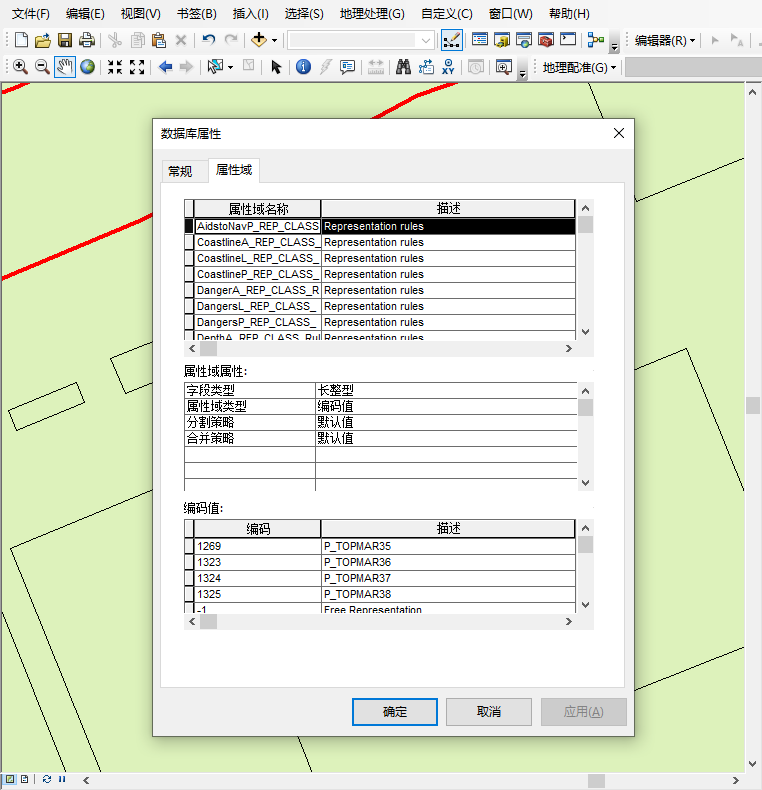
As shown in the figure below, when migrating a shoreline land classification management dataset, the domain information within the data is migrated along with it.
 |
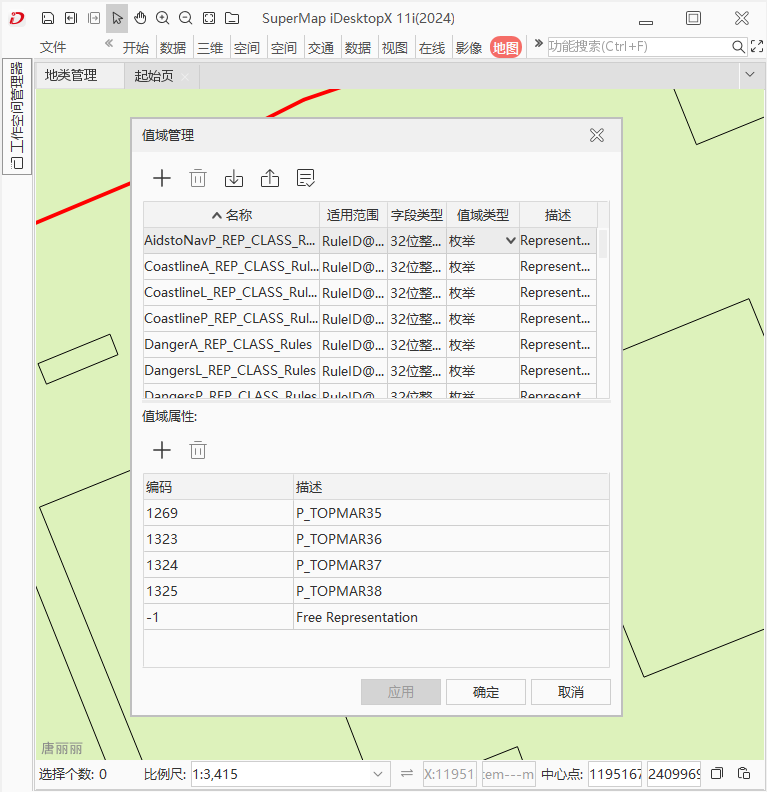 |
| Figure: Domain Information Before Migration | Figure: Domain Information After Migration |
Geodatabase
ArcGIS Geodatabases
ArcGIS geodatabase types include Personal Geodatabases, File Geodatabases, and Enterprise Geodatabases.
- Personal Geodatabase: It is the source data format for ArcGIS geodatabases stored and managed in Microsoft Access data files. The maximum size of this data file is 2 GB and it is only applicable to the Windows operating system.
- File Geodatabase: It is a collection of various types of GIS datasets stored in a file system folder. Each dataset is saved as a file, and the maximum file size can be extended to 1 TB.
- Enterprise Geodatabase (ArcSDE): It is a collection of various types of GIS datasets stored as tables in a relational database, with no limitations on size or the number of users. This type of database uses Oracle, Microsoft SQL Server, IBM Informix, or PostgreSQL for storage in relational databases.
SuperMap Geodatabase
SuperMap SDX+ is a spatial database engine. It can achieve integrated storage of GIS spatial geometry data and attribute data into various relational databases, enabling capabilities such as data editing, index management, and spatial querying. For a detailed description of SuperMap SDX+, please refer to SuperMap SDX+ Spatial Data Engine Special Topic Introduction.
- File-Based Engines
The file-based engines supported by SuperMap SDX+ include: SuperMap's custom UDB/UDBX engines, Shapefile file engine, raw image files engine, vector tile file engine, etc. Among them, UDBX is an extension and enhancement of SuperMap's custom UDB engine, with more stable functionality. The UDB engine is the only file-based spatial data engine in SuperMap Objects' custom format. A data project for the UDB engine includes two files: the file with the UDB extension stores spatial data using OLE compound document technology; the file with the UDD extension is the attribute database, using the SQLite database format. Because UDB/UDBX files use compound document technology, UDB/UDBX files support the storage of both vector data and image data.
- Database Engines
The database engines supported by SuperMap SDX+ mainly target relational database management systems such as Oracle, SQLServer, and Kingbase, as well as Alibaba's POLARDB and Huawei's GaussDB databases. It also supports PostGIS, the native spatial engine in PostgreSQL.
Supported Database Types for Migration
| ArcGIS Geodatabase | SuperMap Geodatabase | With A License | Without A License | ||
| Personal GDB | File-Based/Database | √ | √ | ||
| File GDB | File-Based/Database | √ | √ | ||
| ArcSDE | Oracle | ST_Geometry | File-Based/Database | √ | × |
| SDO_Geometry | File-Based/Database | √ | × | ||
| Oracle Spatial | File-Based/Database | √ | × | ||
| PostgreSQL | ST_Geometry | File-Based/Database | √ | × | |
| PostGIS | File-Based/Database | √ | × | ||
Related Topics