



Feature Description
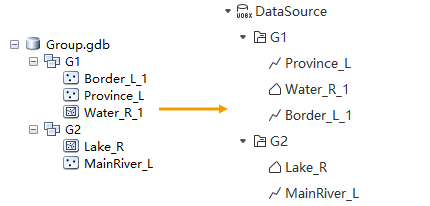
FileGDB (ESRI File Geodatabase) is a common geographic data storage format used to manage and store geographic information data. It supports various data types such as vector data, raster data, topology, attribute tables, etc. It supports migrating data from the FileGDB (*.gdb) folder. If the data contains attachments, the attachments and data can be migrated together to a SuperMap datasource according to the corresponding relationship. During migration, data selection is supported. When migrating to a UDBX datasource, the original grouping structure of data in the GDB file can be retained.
Function Entry
- The Data Migration tab -> ArcGISData Migration -> Import GDB.
Parameter Description
- File Path: GDB file storage path.
- Datasource: The storage location for imported data. Supports importing to an existing or new file-type or database datasource.
- License Validation: Select the ArcMap type. Default indicates the non-official license type of ArcMap. A Check button is provided to view whether the corresponding ArcGIS license information exists on the current machine.
- Charset: The default is automatic reading. The system will automatically read the character set associated with data in the GDB file folder. If you need to change it, you can select other Charset types from the dropdown list.
- Select Data: Check this option to select the data to be migrated in the pop-up Select Data dialog box. It supports selecting groups or datasets under groups. If not checked, all data in the GDB will be imported at once.
The comparison of data results before and after migration is as follows:
 Notes:
When migrating GDB data to a PostGIS database, if the database version is higher than 10.x, you may encounter the error "Database connection failed, please check the data source connection parameter".You need to manually modify the database permissions. The steps are as follows:
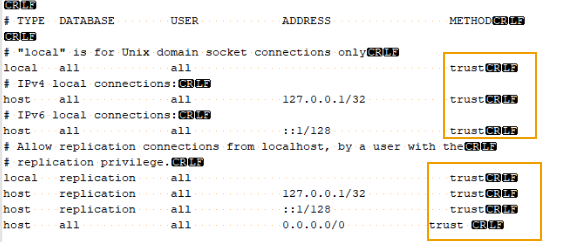
- Open the PostgreSQL installation directory and open the /data/pg_hba.config file under it;
- Modify the METHOD for IPv4 to "trust", save the file, and then restart the database;
- If still unable to connect after modification, try changing other related METHODs in the image below to "trust" and restart the database again.
Note: It is recommended to modify "METHOD for IPv4 to trust" only when migration is needed, and restore the configuration after migration or other operations are completed.
Related Topics