



Feature Description
During data creation and processing, some fragmented polygons may be generated, referred to as shard polygons. The Shard Polygons Merge function can merge these shard polygons into adjacent large polygons or delete isolated shard polygons (isolated shard polygons are not adjacent or tangent to other polygons, making them difficult to merge) to simplify the data.
Generally, polygons with areas far smaller than other polygon objects in the dataset can be considered "shard polygons," typically ranging from one-millionth to one-ten-thousandth of the area of the largest polygon in the same dataset. However, in practical operations, you can set an appropriate minimum polygon based on actual needs. Node snap tolerance is used to determine whether polygons are adjacent. Setting a large tolerance for separated polygon objects or an excessively large tolerance for actually adjacent polygons is unreasonable and may cause failed to merge tiny polygons.
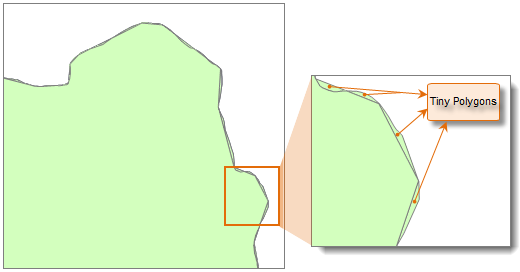
As shown in the figure below, this is the result after performing Shard Polygons Merge on a polygon dataset. Figure 2 shows the effect of merging shard polygons into adjacent large polygons.
 |
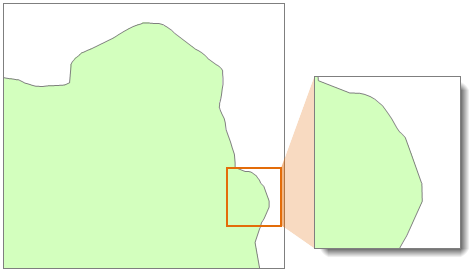 |
| Figure 1: Before merging shard polygons | Figure 2: After merging shard polygons |
Function Entry
- Data tab -> Data Processing -> Vector -> Shard Polygons Merge.
- Toolbox -> Data Processing -> Vector -> Shard Polygons Merge.
Parameter description
In the Shard Polygons Merge dialog box, add the dataset to be processed for shard polygons merge via the toolbar and perform united value settings. Set parameters in the list box, including node snap tolerance, combine mode, broken polygon area, automatically remove isolated small polygons, etc.
- Source Dataset: The data source where the dataset containing shard polygons to be merged is located;
- Result Data: Specify the data source for storing result data and the dataset name;
- Parameters
- Broken polygon area: The default value is 0. You can manually enter a value based on actual conditions. Polygons with an area smaller than this value will be merged. The unit depends on the dataset unit; for example, if the dataset unit is meters, then the parameter unit is square meters.
- Tolerances: If the distance between two nodes is less than this tolerance value, the system will automatically merge these two nodes into one node during the merging process. The default tolerance is related to the dataset's coordinate system. For specific details, please refer to Tolerance Description.
- Combine Mode: Specifies the shard polygons merge method, supporting two modes: "Merge by Area" and "Merge by Common Boundary"
- Merge by Area: Merges shard polygons into the adjacent polygon with the largest area;
- Merge by Common Boundary: Merges shard polygons into the adjacent polygon with the longest common boundary.
- Automatically remove isolated small polygons: Used to specify whether to automatically remove isolated small polygons. By default, it is not checked. After checking, isolated polygons with an area smaller than the specified minimum polygon will be deleted, as shown in Figure 3:
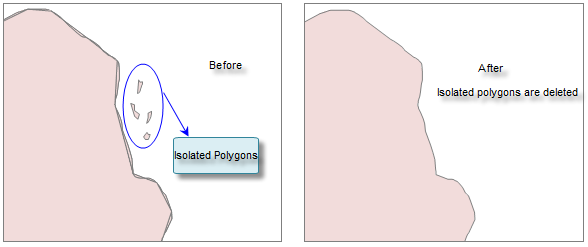
Figure 3: Delete single region - Group Field: Specifies the grouping field. Geometries with the same field value will be grouped together, and only polygons with the same field value can be merged;
- Priority field of the merged object: Priority field of the merged object. You can specify one or more priority fields.
When specifying multiple priority fields, compare them in the order of the fields. If field values are equal, they are considered matching objects. If there is no unique matching object for the highest priority field value, continue comparing the next highest priority field. This process continues until all priority fields are compared, and finally merge with the adjacent object that uniquely matches the priority fields.
If the priority field is empty or there is no unique matching object, merge based on the principle of maximum area, i.e., merge shard polygons into the adjacent largest polygon.
Related Topics
Compute the Bounding Rectangle