

Feature Description
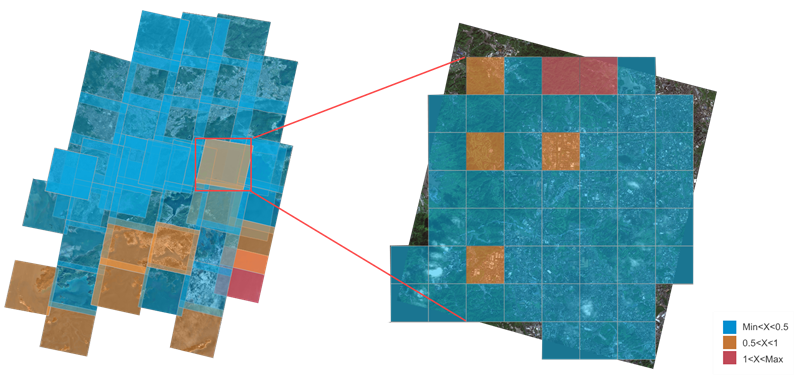
Fine plane accuracy evaluation analyzes the distribution of correction errors within different partitions by dividing the image into multiple zones based on specified areas and detecting the correction accuracy within each zone. This evaluation method helps gain a deeper understanding of the geometric accuracy of the image in different areas, providing important references for image quality assessment and optimization.
Only supports DOM data.
Supported starting from SuperMap ImageX Pro 11i(2024).
![]() |
| Figure: Plane accuracy (left) and fine plane accuracy (right) |
Function Entry
Imagery Tab -> Satellite Data Processing Group -> Fine Plane Accuracy .
Parameter Description
- Accuracy Evaluation Type: Provides three types: Fine Plane Accuracy and Fine Edge Matching Accuracy, Fine Plane Accuracy, and Fine Edge Matching Accuracy.
- Fine Plane Accuracy and Fine Edge Matching Accuracy: Outputs correction accuracy reports for image plane and edge matching.
- Fine Plane Accuracy: Only outputs the image plane correction accuracy report.
- Fine Edge Matching Accuracy: Only outputs the image edge matching accuracy report.
- Image To Be Checked: Sets the mosaic dataset containing the image to be checked. The orthophoto within the mosaic dataset is used by default. If there is no orthophoto, the first mosaic dataset is used. Provides four ways to input image files: Add File, Add Folder, Add List, Add Mosaic Data. When selecting Add Folder, all image files within that folder (including subfolders) will be automatically retrieved.
- Reference Image: Sets the mosaic dataset containing the reference image. Provides four ways to input image files: Add File, Add Folder, Add List, Add Mosaic Data. When selecting Add Folder, all image files within that folder (including subfolders) will be automatically retrieved.
- Detection Partition:
- Range Data Source: Sets the data source containing the bounds dataset for the area to be detected.
- Bounds Dataset: Sets the bounds dataset for the area to be detected. Partitioning and detection will be performed based on this dataset. If not set, the entire image will be detected by default.
- Partition Area: Sets the area of each minimum partition, default is 1, unit is km2.
- Number of Partitions: Displays the number of segments the detection range is divided into under the current partition area, unit is Count.
- Checkpoint Parameters:
- Matching Method: Provides the following six matching methods. Choose based on data characteristics and needs. Among them, AFHORP and RIFT support multi-modal data matching; CASP and DEEPFT are based on deep learning and require additional AI model configuration and CUDA environment installation. Generally, it is recommended to use MOTIF, CASP, or DEEPFT.
- MOTIF (default): A template matching algorithm for multi-modal images, characterized by using lightweight feature descriptors. MOTIF can overcome nonlinear radiation distortions caused by differences between SAR and optical images.
- CASP: A novel cascaded matching pipeline that benefits from integrating high-level features, helping to reduce the computational cost of low-level feature extraction. The pipeline decomposes the matching stage into two progressive phases: first establishing one-to-many correspondences at a coarser scale as cascaded priors. Then, using these priors for guidance to determine one-to-one matches at the target scale.[1]
- DEEPFT: An image matching method based on deep learning.
- SIFT: A method for extracting distinctive invariant features from images, which can be used for reliable matching between objects or scenes under different viewing conditions.
- RIFT: A feature matching algorithm robust to large-scale nonlinear radiation distortions. It improves the stability of feature detection and overcomes the limitations of feature description based on gradient information.
- AFHORP: A feature matching algorithm for multi-modal images. AFHORP is highly resistant to radiation distortion and contrast differences in multi-modal images and performs excellently in solving orientation reversal and phase extremum mutation issues.
- Minimum Points Per Partition: Sets the minimum number of points to generate on each partition. The actual number generated may be lower due to insufficient regional features. Default value is 50, recommended not less than 25.
- Maximum Points Per Partition: Sets the maximum number of points to generate on each partition. The actual number generated may exceed this value due to algorithm requirements. Default value is 200.
- Search Distance:
- When the matching method is MOTIF, sets the search radius for seed points in image matching. Range is [0,256], default is 40, unit is px. A larger search radius increases the matching range and processing time.
- For other matching methods, this parameter is not provided.
- Residual Threshold: Sets the error threshold for checkpoints. Range is [0, 40], default is 5, unit is px. A larger threshold saves more reference points but increases the probability of saving erroneous points.
- Error Unit: Sets the unit for accuracy tolerance. Options are px, m, °, default is px.
- Accuracy Tolerance: Specifies the tolerance for fine plane accuracy evaluation. Based on the overall root-mean-square error (RMSE) of the checkpoints, it counts checkpoints less than the tolerance, 1-2 times the tolerance, and greater than 2 times the tolerance to evaluate checkpoint quality. Default is 5, can be filled according to specific project acceptance standards.
- Edge Matching Accuracy Tolerance: Specifies the tolerance for fine edge matching accuracy evaluation. Based on the overall root-mean-square error (RMSE) of the checkpoints, it counts checkpoints less than the tolerance, 1-2 times the tolerance, and greater than 2 times the tolerance to evaluate checkpoint quality. Default is 5, can be filled according to specific project acceptance standards.
- Exclude Building Area Points: When checked, automatically detects building areas in the image and excludes checkpoints within those building areas.
- Matching Method: Provides the following six matching methods. Choose based on data characteristics and needs. Among them, AFHORP and RIFT support multi-modal data matching; CASP and DEEPFT are based on deep learning and require additional AI model configuration and CUDA environment installation. Generally, it is recommended to use MOTIF, CASP, or DEEPFT.
- Result: The display of the evaluation result is similar to the Plane Accuracy Report. In addition to the overall quality control (QC) report, fine plane accuracy evaluation provides checkpoint details in a partitioned form.
- Output Coordinate System: Sets the coordinate system for the output result region dataset and checkpoints, facilitating overlay display with other data. Default is GCS_WGS_1984.
- Report Directory: In the Report Directory, set the export directory for the quality inspection report. The report name is: QualityReport_Region.html.
- Export To Excel: Check this box to output the report in Excel file format. If not checked, it will be output in the default HTML file format.
Related Topics
References
[1] Chen, P., Yu, L., Wan, Y., Pei, Y., Liu, X., Yao, Y., ... & Zhang, Y. (2025). CasP: Improving Semi-Dense Feature Matching Pipeline Leveraging Cascaded Correspondence Priors for Guidance. In Proceedings of the IEEE/CVF International Conference on Computer Vision (pp. 28063-28072).
