
Planar Accuracy Evaluation

Feature Description

planar accuracy evaluation is used to detect the error distribution of image planar accuracy or edge matching accuracy.

  • Plane Accuracy: Refers to the plane position root-mean-square error (RMSE) of a Digital Orthophoto Map (DOM).

  • Edge matching accuracy: Refers to the root-mean-square error (RMSE) at the junction between a Digital Orthophoto Map and its adjacent image map.

Through planar accuracy evaluation, the error distribution characteristics of the image can be understood to judge whether it meets the actual production accuracy requirements, providing an important basis for image quality control and application.

Function constraint description: Only supports Dom data.

Supported starting from SuperMap ImageX Pro 11i(2024) version.

Function Entry

Imagery Tab->Satellite data processing Group->Plane Accuracy.

Parameter description

Parameter Name parameter interpretation Parameter Type
Accuracy Evaluation Type

Provides three types:

  • Planar accuracy and edge matching accuracy (Default): Outputs the image planar and edge matching correction accuracy report.
  • Plane Accuracy: Only outputs the image planar correction accuracy report.
  • Edge matching accuracy: Only outputs the image edge matching accuracy report.
AccuracyGradeType
Image to be checked List

Manages image files to be inspected.

  • Add Image: Sets the images requiring accuracy evaluation. Supports formats: *.tiff, *.tif, *.img, *.pix.
    • Add File: Select one or more image files from the local directory.
    • Add Folder: Select a folder from the local directory, and all images in that folder and its subfolders will be automatically retrieved.
    • Add List: Select a manifest file (*.csv) from the local directory. Images will be retrieved based on the image names and path information in the manifest file.
    • Add Mosaic Data: Select a mosaic dataset from the current workspace.
  • Select All: Select all files in the list.
  • Select Reverse: Invert the selection status of all files in the list.
  • Delete: Remove the selected records from the list.
String
reference image

Available when the Accuracy Evaluation Type includes Plane Accuracy.

Manages the reference image file.

  • Add Image: Sets the reference image file. Supports formats: *.tiff, *.tif, *.img, *.pix.
    • Add File: Select one or more image files from the local directory.
    • Add Folder: Select a folder from the local directory, and all images in that folder and its subfolders will be automatically retrieved.
    • Add List: Select a manifest file (*.csv) from the local directory. Images will be retrieved based on the image names and path information in the manifest file.
    • Add Mosaic Data: Select a mosaic dataset from the current workspace.
  • Select All: Select all files in the list.
  • Select Reverse: Invert the selection status of all files in the list.
  • Delete: Remove the selected records from the list.
String
Existing Checkpoints

Available when the Accuracy Evaluation Type includes Plane Accuracy.

Used to set existing checkpoint data to improve the quality of accuracy inspection. Supported formats: UDBX/UDB, GeoJson, ShapeFile. It is recommended that the imported data contains valid coordinate information, and that checkpoints are evenly distributed, of moderate quantity, and reasonably located to ensure reliable quality inspection results.

String
matching method

Provides the following six matching methods. Choose based on data characteristics and requirements. Among them, the AFHORP and RIFT methods support multimodal data matching; CASP and DEEPFT are based on deep learning and require additional configuration of AI models and installation of the CUDA environment. Generally, it is recommended to use MOTIF, CASP, or DEEPFT.

  • MOTIF (Default): A template matching algorithm for multimodal images, characterized by using lightweight feature descriptors. MOTIF can overcome nonlinear radiometric distortion caused by differences between SAR and optical images.
  • CASP: A novel cascade matching pipeline that benefits from integrating high-level features, helping to reduce the computational cost of low-level feature extraction. This pipeline decomposes the matching stage into two progressive phases. First, it establishes one-to-many correspondences at a coarser scale as cascade priors. Then, it uses these priors for guidance to determine one-to-one matches at the target scale. [1]
  • DEEPFT: A deep learning-based image matching method.
  • SIFT: A method for extracting distinctive invariant features from images, useful for reliable matching between objects or scenes under different viewpoints.
  • RIFT: A feature matching algorithm robust to large-scale nonlinear radiometric distortion. It can improve the stability of feature detection and overcome the limitations of feature description based on gradient information.
  • AFHORP: A feature matching algorithm for multimodal images. AFHORP has strong resistance to radiometric distortion and contrast differences in multimodal images, performing excellently in solving problems like direction reversal and abrupt phase extremes.
ImageMatchMethod
Single-Scene Seed Point Count

Available when the Accuracy Evaluation Type includes Plane Accuracy.

Sets the number of seed points to generate checkpoints on a single-scene image. The actual number of detected points may be less than this value.

  • The default value is 1000 when the matching method is MOTIF.
  • For other matching methods, the default value is 200.
Integer
Edge Matching Seed Point Count

Available when the Accuracy Evaluation Type includes Edge matching accuracy.

Sets the number of seed points to generate checkpoints in the image overlap area. The actual number of detected points may be less than this value.

  • The default value is 1000 when the matching method is MOTIF.
  • For other matching methods, the default value is 200.
Integer
search distance

Available only when the Matching method is MOTIF.

Sets the search radius for seed points during image matching. Value range: [0,256]. Default is 40. Unit is px. A larger radius means a larger matching range and longer processing time.

Double
Residual Threshold Sets the residual threshold for checkpoints. Value range: [0,40]. Default value is 5, Unit is px. A larger threshold retains more reference points but increases the probability of incorrect points. Double
Error Unit Refers to the unit for plane accuracy tolerance and edge matching accuracy tolerance. Provides three options: px, m, °. Default is px. AreaUnit
Plane Accuracy Tolerance

Available when the Accuracy Evaluation Type includes Plane Accuracy.

Specifies the tolerance for planar accuracy evaluation. Based on the overall root-mean-square error (RMSE) of the checkpoints, it will count checkpoints with errors less than the tolerance, between 1-2 times the tolerance, and greater than 2 times the tolerance to evaluate the quality of the checkpoints. Default value is 5. Can be filled according to specific project acceptance standards.

Double
Edge Matching Accuracy Tolerance

Available when the Accuracy Evaluation Type includes Edge matching accuracy.

Specifies the tolerance for edge matching accuracy evaluation. Based on the overall root-mean-square error (RMSE) of the checkpoints, it will count checkpoints with errors less than the tolerance, between 1-2 times the tolerance, and greater than 2 times the tolerance to evaluate the quality of the checkpoints. Default value is 5. Can be filled according to specific project acceptance standards.

Double
Image Minimum Overlap Area

Unavailable when the Accuracy Evaluation Type includes Plane Accuracy and the Existing Checkpoints parameter is set.

If the overlap between images to be checked, or between images to be checked and the reference image, is less than the set threshold, no accuracy quality inspection will be performed. Default value is 0. Unit is km\u00B2. Supports switching the unit to m\u00B2, yd\u00B2, or square mile.

Double
Exclude Building Area Points

Unavailable when the Accuracy Evaluation Type includes Plane Accuracy and the Existing Checkpoints parameter is set.

When checked, it will automatically detect building areas in the images and exclude checkpoints within building areas.

Boolean
Output Coordinate System Sets the coordinate system for the output result region dataset and checkpoints, facilitating overlay display with other data. Default value is GCS_WGS_1984. PrjCoordSys
Report Directory Sets the export directory for the quality inspection report. The plane accuracy quality control (QC) report is named: QualityReport.html. The edge-matching accuracy quality control (QC) report is named: QualityReport_Edge.html. String
Export to Excel Check this box to output the report in Excel File format. If unchecked, it will output in the default html file format. Boolean

Output Result

Taking the plane accuracy quality control (QC) report as an example, the report results include the overall quality control (QC) report, the quality inspection result map, single-scene quality control (QC) report, checkpoint quality control (QC) report, checkpoint error, etc.

  • Overall quality control (QC) report: Provides an overall report for all checkpoints within the check image range, as shown below.

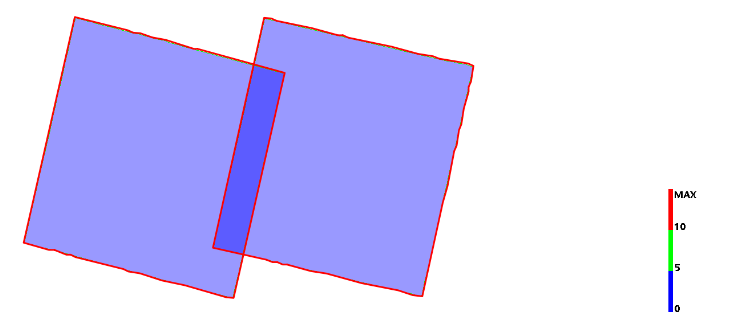
  • Quality inspection result map: Uses color grading to represent the error distribution within the detection range. As shown below, all objects in the map are within the 0-5 tolerance grading, indicating compliance with accuracy requirements.

  • Single-scene quality control (QC) report: Statistics on checkpoints based on the range of the detected image, with checkpoint error values calculated per partition.

  • Checkpoint quality control (QC) report: Extracts each row from the single-scene quality control (QC) report table separately and provides the checkpoint error below that table.

  • Checkpoint error: Provides all checkpoint information on that image based on the single-scene image range. The figure below shows partial checkpoint information.

Related Topics

Fine Plane Accuracy

Checkpoint Management

Deformation detection

References

[1] Chen, P., Yu, L., Wan, Y., Pei, Y., Liu, X., Yao, Y., ... & Zhang, Y. (2025). CasP: Improving Semi-Dense Feature Matching Pipeline Leveraging Cascaded Correspondence Priors for Guidance. In Proceedings of the IEEE/CVF International Conference on Computer Vision (pp. 28063-28072).