



Feature Description
Users can modify the parameters of a custom thematic map in the "Custom Thematic Map" window to achieve a more suitable thematic map effect.
The default display for fields in the field drop-down list in a custom thematic map is the Field Alias. If necessary, you can switch to the field name in the File tab -> Options group. For details, refer to the Preference Settings document.
Operation Steps
When creating custom thematic maps based on area layers, line layers, and point layers respectively, the content that can be set in the "Thematic Map" window differs slightly. Area layer thematic maps support "Fill" and "Line Style" settings, line layer thematic maps support "Line Style" settings, and point layer thematic maps support "Symbol" settings.
- Double-click a custom thematic map layer in the Layer Manager. The "Thematic Map" window that pops up displays the settings information for the selected custom thematic map.
- Thematic Map Layer: Displays the name of the currently displayed thematic map.
- Properties: The "Properties" item in the "Thematic Map" window is used to set the fill style, line style, and marker style of the thematic map. The fill style is effective for area objects in area vector thematic map layers, the line style is effective for line objects in line vector thematic map layers and the borders of area objects in area vector thematic map layers, and the marker style is effective for point objects in point vector thematic map layers.
Fill: Sets the rendering style for area objects in an area layer.
-
- Fill Style: Select a numeric field or expression. The object will be filled based on the style corresponding to the ID in the resource fill library that matches the value of this field or expression. For example, after setting a fill style field, if the value of this field for an object is 8, the system will search the resource fill library for the fill style with ID 8 and use that style to render the object.
- Transparency: Select a numeric field or expression. The value of this field or expression represents the transparency of the corresponding object's fill style. For example, an object with a field value of 0 will be rendered completely opaque, while an object with a field value of 100 will be rendered completely transparent. Values less than 0 or greater than 100 are treated as completely opaque.
- Fill Foreground Color: Select a numeric field or expression. The value of this field or expression is used to set the fill foreground color. The system reads the decimal color value in RGB Color Mode by default. For example, to set the fill foreground color to blue, whose hexadecimal value is #0003E8, you need to convert this hexadecimal value to decimal, which is 1000. Therefore, the field value here should be set to 1000, and the map will display it as blue.
Note: If you do not know what color a decimal value represents when editing the color value, you can use the Display Hexadecimal Value function to directly enter the hexadecimal color value in the attribute table.
- Fill Background Color: Select a numeric field or expression. The value of this field or expression is used to set the fill background color. The color settings are the same as for "Fill Foreground Color".
- Gradient Style: Select a numeric field or expression. The value of this field or expression determines the gradient mode of the fill style. If the field value is 1, a linear gradient is used; if it is 2, a circular gradient is used; if it is 3, a conical gradient is used; if it is 4, a square gradient is used; for any other value, no gradient is used.
- Gradient Angle: Select a numeric field or expression. The value of this field or expression is used to set the rotation angle of the gradient fill. The default value is 0 degrees. If the field value is greater than 0, it represents rotating counterclockwise by the corresponding angle; otherwise, it represents rotating clockwise by the corresponding angle. The unit is 1 degree.
- Gradient Horizontal Offset: Select a numeric field or expression. The value of this field or expression is used to set the offset x (as a percentage) of the gradient fill center point relative to the center point of the fill range. This is only available for circular, conical, and square gradient modes. Positive values shift right, negative values shift left.
- Gradient Vertical Offset: Select a numeric field or expression. The value of this field or expression is used to set the offset y (as a percentage) of the gradient fill center point relative to the center point of the fill range. This is only available for circular, conical, and square gradient modes. Positive values shift up, negative values shift down.
- Line Style: Sets the rendering style for line objects in a line layer, or the border style for area objects in an area layer.
- Line Style: Select a numeric field or expression. The object will be rendered based on the style corresponding to the ID in the resource line style library that matches the value of this field or expression. For example, after setting a line style field, if the value of this field for an object is 8, the system will search the resource line style library for the line style with code 8 and use that style to render the line object.
- Line Color: Select a numeric field or expression. The value of this field or expression is used to set the line color. The color settings are the same as for "Fill Foreground Color".
- Line Width: Select a numeric field or expression. The value of this field or expression is used to set the width of the selected line style. The unit is 0.1 mm.
- Symbol: Sets the rendering style for point objects in a point layer.
- Marker Style: Select a numeric field or expression. The object will be rendered based on the style corresponding to the ID in the resource symbol library that matches the value of this field or expression. For example, after setting a marker style field, if the value of this field for an object is 8, the system will search the resource symbol library for the marker style with code 8 and use that style to render the point object.
- Symbol Color: Select a numeric field or expression. The value of this field or expression is used to set the point symbol color. The system first converts this field value to a hexadecimal number and then selects its corresponding color. The color settings are the same as for "Fill Foreground Color".
- Symbol Size: Select a numeric field or expression. The value of this field or expression is used to set the size of the selected symbol. The unit is 0.1 mm. Note: Setting it to 0 means displaying at the original size, and setting it to a negative number means the symbol is not displayed.
- Symbol Width: Select a numeric field or expression. The value of this field or expression is used to set the width of the selected symbol.
- Symbol Height: Select a numeric field or expression. The value of this field or expression is used to set the height of the selected symbol.
 Note:
Note:Marker Size and Symbol Width/Height are mutually exclusive. When you set one of them, the setting for the other will become invalid.
- Rotate: Select a numeric field or expression. The value of this field or expression is used to set the rotation angle of the point symbol. If the field value is greater than 0, it represents rotating counterclockwise by the corresponding angle; otherwise, it represents rotating clockwise by the corresponding angle. The unit is degrees.
- RGB Vertex Color: Check this checkbox. The user-defined fill color, line color, and symbol color will be displayed according to the RGB vertex color by default. If this checkbox is not checked, the colors will be displayed according to the BGR color values.
-
- Custom thematic maps created and modified by users can be saved as templates for application to thematic map creation for other layers. For details on saving as a thematic map template, refer to: Save to Thematic Map Template Library.
- The values of fields and expressions correspond to the ID values in the symbol library. Taking the marker symbol library as an example, open Workspace -> Symbol Library -> Marker Symbol Library. The method for viewing ID values is shown in the figure below:
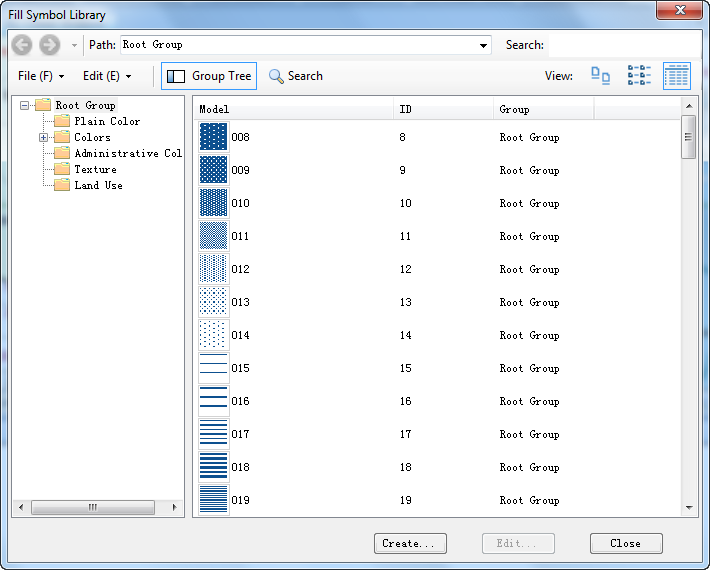
Marker Symbol Library ID Viewing Window
Related Topics