

Class TransportationAnalystSetting
- java.lang.Object
-
- com.supermap.services.providers.UGCDatasetConnectionInfo
-
- com.supermap.services.providers.TransportationAnalystSetting
-
- All Implemented Interfaces:
- MultiInstanceSupported, java.io.Serializable
public class TransportationAnalystSetting
extends UGCDatasetConnectionInfo
implements MultiInstanceSupported
Traffic network analysis environment settings class, that is, network data set connection information.
- See Also:
- Serialized Form
-
-
Field Summary
Fields Modifier and Type Field and Description java.lang.BooleanautoCheckNetworkWhether to automatically check the network datasetjava.lang.String[]backwardSingleWayRuleValuesAn array of strings representing the backward single way.int[]barrierEdgesThe obstacle arc ID array identifies which network arcs are the obstacle arcs.int[]barrierNodesThe obstacle node ID array identifies which network nodes are the obstacle nodes.static intDEFAULT_POOLSIZEjava.lang.StringdirectionFieldFlow fieldjava.lang.StringedgeIDFieldThe field name that identifies the network arc ID.java.lang.StringedgeNameFieldThe field name that identifies the network arc name.java.lang.String[]forwardSingleWayRuleValuesAn array of strings representing the forward single way.java.lang.StringfromNodeIDFieldIdentifies the field name of the arc start node ID.booleaninitFacilityAnalystWhether to initialize facility network analysisjava.lang.StringnodeIDFieldThe field name that identifies the network node ID.java.lang.StringnodeIDFilterFieldIn facility network analysis upstream and downstream key facility lookup, it generates filter fields for default sourceNodeIDs parametersjava.lang.StringnodeNameFieldThe field name that identifies the network node name.java.lang.StringpathGuideDescriptionLanguageSpecify the travel guidance language by setting the properties file suffix.intpoolSizeThe maximum number of concurrency allowed for traffic transfer analysis.java.lang.String[]prohibitedWayRuleValuesIndicates an array of strings representing lines.java.lang.StringruleFieldIndicates the field name of the network arc traffic rules.doubletoleranceThe distance tolerance from the node to the arc.java.lang.StringtoNodeIDFieldIdentifies the field name of the arc stop node ID.TurnDatasetInfoturnDatasetInfoSteering table data set.java.lang.String[]twoWayRuleValuesAn array of strings representing the two way.WeightFieldInfo[]weightFieldInfosA set of weight field information,is a necessary parameter.-
Fields inherited from class com.supermap.services.providers.UGCDatasetConnectionInfo
datasetName, datasourceName, workspaceConnectString, workspaceType
-
-
Constructor Summary
Constructors Constructor and Description TransportationAnalystSetting()The Constructor.TransportationAnalystSetting(TransportationAnalystSetting transportationAnalystSetting)Copy constructor.
-
Method Summary
Methods Modifier and Type Method and Description TransportationAnalystSettingclone()booleanequals(java.lang.Object obj)Compare whether the specified object is equal to the currentUGCDatasetConnectionInfoobject.inthashCode()Gets the hash code value of the SuperMap dataset link information object.booleanisMultiInstance()Returns whether the current service provider is enabledvoidsetMultiInstance(boolean isMultiInstance)Sets whether the current service provider is enabled
-
-
-
Field Detail
-
DEFAULT_POOLSIZE
public static final int DEFAULT_POOLSIZE
-
ruleField
public java.lang.String ruleField
Indicates the field name of the network arc traffic rules.
Network arc traffic rules can be divided into positive one-way line, reverse one-way line, double line, forbidden line and so on. In the network dataset An arc has a start node and an end node, and from the beginning node to the end node is positive, and vice versa.
Refer to
Can be modified theoretically, but should be modified to the value specified inforwardSingleWayRuleValuesfor the traffic rule valus corresponding to the forward single way, Refer tobackwardSingleWayRuleValuesfor the traffic rule valus corresponding to the backward sngle way, Refer totwoWayRuleValuesfor the traffic rule valus corresponding to the two way.backwardSingleWayRuleValues, , ,
-
forwardSingleWayRuleValues
public java.lang.String[] forwardSingleWayRuleValues
An array of strings representing the forward single way.
When the value of the field specified by
ruleFieldis one of them, the arc is the forward single way.Network arc traffic rules can be divided into positive one-way line, reverse one-way line, double line, forbidden line and so on. In the network dataset An arc has a start node and an end node, and from the beginning node to the end node is positive, and vice versa.
-
backwardSingleWayRuleValues
public java.lang.String[] backwardSingleWayRuleValues
An array of strings representing the backward single way.
When the value of the field specified by
ruleFieldis one of them, the arc is the backward single way.Network arc traffic rules can be divided into positive one-way line, reverse one-way line, double line, forbidden line and so on. In the network dataset An arc has a start node and an end node, and from the beginning node to the end node is positive, and vice versa.
-
twoWayRuleValues
public java.lang.String[] twoWayRuleValues
An array of strings representing the two way.
When the value of the field specified by
ruleFieldis one of them, the arc is the two way.Network arc traffic rules can be divided into positive one-way line, reverse one-way line, double line, forbidden line and so on. In the network dataset An arc has a start node and an end node, and from the beginning node to the end node is positive, and vice versa. The two way indicates that the traffic rules of the network arc can be reversed either forward or backward.
-
prohibitedWayRuleValues
public java.lang.String[] prohibitedWayRuleValues
Indicates an array of strings representing lines.
When the value of the field specified by
ruleFieldis one of them, the arc is forbidden line.Network arc traffic rules can be divided into positive one-way line, reverse one-way line, double line, forbidden line and so on. Forbidden lines indicate that the arc is prohibited in traffic rules.
-
barrierEdges
public int[] barrierEdges
The obstacle arc ID array identifies which network arcs are the obstacle arcs.
The arc ID is not necessarily the value of the SmID field, but the value of the field specified by
edgeIDField.
-
barrierNodes
public int[] barrierNodes
The obstacle node ID array identifies which network nodes are the obstacle nodes.
The node ID is not necessarily the value of the SmID field, but the value of the field specified by
nodeIDField.
-
edgeIDField
public java.lang.String edgeIDField
The field name that identifies the network arc ID. Once this field is set, it will take effect throughout the analysis.
The default value is "SmEdgeID".
Can not be modified
-
edgeNameField
public java.lang.String edgeNameField
The field name that identifies the network arc name.
Can be modified
-
nodeIDField
public java.lang.String nodeIDField
The field name that identifies the network node ID. The value of this field represents the ID of a node, which takes effect throughout the analysis once set.
The default value is “SmNodeID”.
Can not be modified
-
nodeNameField
public java.lang.String nodeNameField
The field name that identifies the network node name.
Can be modified
-
fromNodeIDField
public java.lang.String fromNodeIDField
Identifies the field name of the arc start node ID.
The default value is “SmFNode”.
Can not be modified
-
toNodeIDField
public java.lang.String toNodeIDField
Identifies the field name of the arc stop node ID.
The default value is “SmTNode”.
Can not be modified
-
tolerance
public double tolerance
The distance tolerance from the node to the arc.
In principle, the network analysis can specify any point in the network as a site in the path analysis, The site should be near the network. If this point is not on the network (neither on the arc nor on the node), The network analysis will attribute the site to the network based on the distance tolerance. As shown below, the orange dot represents the network node, blue for the arc, gray point for the site, the red line segment is the distance from the site to the arc AB, and if the distance in the set distance tolerance, the site is attributed to the arc AB.
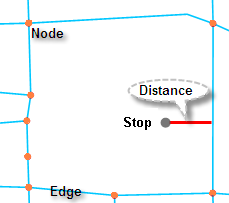
Set the appropriate distance tolerance in order to ensure the normal network analysis, and when the specified point within the tolerance range, the point will be attributed to the network, In the network analysis, will take the corresponding arc (such as the above mentioned arc AB) of the starting node and the termination of the node as the site to be calculated respectively, And then take the minimum calculation results.
The distance tolerance value can be calculated by the following method:
- Calculate the smallest circumscribed rectangle that contains all the objects in the network dataset;
- Calculate the height and width of the rectangular object;
- Take the smaller of the two by dividing by 40 to find the appropriate distance tolerance.
The default value is 0.01, the unit is the same as the current data set coordinate unit (coordUnit).
-
weightFieldInfos
public WeightFieldInfo[] weightFieldInfos
A set of weight field information,is a necessary parameter.
Via the weight field information (
WeightFieldInfo) You can get the field names that represent the forward and negative weights.WeightFieldInfo.backWeightFieldandWeightFieldInfo.forwardWeightField, theoretically can be modified
-
turnDatasetInfo
public TurnDatasetInfo turnDatasetInfo
Steering table data set.
, , can not be modified.# weightFieldscan be modified
-
pathGuideDescriptionLanguage
public java.lang.String pathGuideDescriptionLanguage
Specify the travel guidance language by setting the properties file suffix. If it is set to zh_CN, the program will use com \ supermap \ services \ providers \ UGCTransportationAnalystProviderResource_zh_CN.properties in the text to generate travel guidance information. If it is set to en_US, and you will be the corresponding use com \ supermap \ services \ providers \ UGCTransportationAnalystProviderResource_en_US.properties. If the wrong value is set or not set, the file name without suffix is used, and the system decides which language to use.
-
poolSize
public int poolSize
The maximum number of concurrency allowed for traffic transfer analysis.
The default value is
Runtime.availableProcessors()。
-
autoCheckNetwork
public java.lang.Boolean autoCheckNetwork
Whether to automatically check the network dataset
-
directionField
public java.lang.String directionField
Flow field
-
initFacilityAnalyst
public boolean initFacilityAnalyst
Whether to initialize facility network analysis
-
nodeIDFilterField
public java.lang.String nodeIDFilterField
In facility network analysis upstream and downstream key facility lookup, it generates filter fields for default sourceNodeIDs parameters
-
-
Constructor Detail
-
TransportationAnalystSetting
public TransportationAnalystSetting()
The Constructor.
-
TransportationAnalystSetting
public TransportationAnalystSetting(TransportationAnalystSetting transportationAnalystSetting)
Copy constructor.
- Parameters:
transportationAnalystSetting- traffic network analysis environment setting object.
-
-
Method Detail
-
equals
public boolean equals(java.lang.Object obj)
Description copied from class:UGCDatasetConnectionInfoCompare whether the specified object is equal to the current
UGCDatasetConnectionInfoobject.- Overrides:
equalsin classUGCDatasetConnectionInfo- Parameters:
obj- the object that is compared with the currentUGCDatasetConnectionInfoobject.- Returns:
- returns true if the specified object is equal to the SuperMap dataset link information object, false otherwise.
-
hashCode
public int hashCode()
Description copied from class:UGCDatasetConnectionInfoGets the hash code value of the SuperMap dataset link information object.
- Overrides:
hashCodein classUGCDatasetConnectionInfo- Returns:
- hash code value.
-
clone
public TransportationAnalystSetting clone()
- Overrides:
clonein classjava.lang.Object
-
isMultiInstance
public boolean isMultiInstance()
Description copied from interface:MultiInstanceSupportedReturns whether the current service provider is enabled
- Specified by:
isMultiInstancein interfaceMultiInstanceSupported- Returns:
-
setMultiInstance
public void setMultiInstance(boolean isMultiInstance)
Description copied from interface:MultiInstanceSupportedSets whether the current service provider is enabled
- Specified by:
setMultiInstancein interfaceMultiInstanceSupported
-
-