



Single view DSM production workflow
A Single view DSM refers to a Digital Surface Model generated from a single stereo pair (or a single aerial photography mission) without multi-scene mosaicking. It comprehensively records the top altitude information of all surface features (ground, vegetation, buildings, etc.) from the sensor's perspective, and is often used in the following scenarios:
- Fine-Scale Feature Extraction and Analysis for Small Areas: Extracting outlines of individual buildings, calculating building height and volume, analyzing the canopy structure of individual or small stands of trees.
- High-Timeliness Emergency Response: Rapid assessment of individual building damage, distribution of fallen trees, or coverage of lava flows after earthquakes, landslides, or volcanic eruptions.
- Scientific Experiments and Parameter Sensitivity Studies: Comparing differences in DSMs generated by different sensors or algorithms (e.g., dense matching algorithms); studying surface changes of specific terrains or features (e.g., glaciers, sand dunes).
The workflow is described as follows:
- Set Image Path (dsm/dem): Set information such as the original image, reference image, and result data processing path.
- Generate Connection Points: Automatically generate connection points in overlapping areas of images, used for mosaicking and adjusting multiple satellite images to ensure geometric consistency between them.
- Generate Ground Control Points: Generate ground control points based on image feature points, used for high-precision geometric correction and position tracking to ensure the geographical location accuracy of the images.
- Block Network Adjustment: Based on connection points and ground control points, obtain the orientation parameters of satellite images through adjustment calculation.
- Generate DSM: Generate point cloud data through a dense matching algorithm and obtain DSM data through interpolation processing.
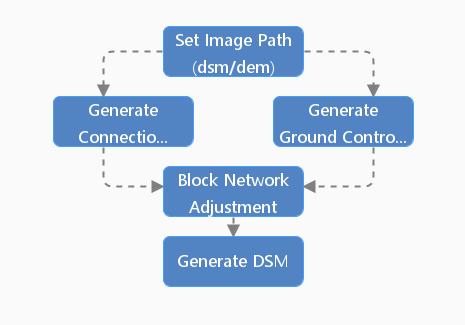 |
| Figure: Single view DSM production workflow |