



Single-scene DEM production workflow
A single-scene DEM refers to a digital elevation model generated from a single stereo pair (or a single aerial photography mission) without multi-scene mosaic processing. It typically plays a role in the following scenarios:
- Small-scale research: When the study area is entirely within the coverage of a single-scene image (such as a single mountain, lake, development zone, or engineering site), using a single-scene DEM can avoid edge errors caused by mosaicking, ensuring the inherent high precision of analyst results.
- Emergency response: In emergency situations such as disaster monitoring (e.g., landslides, floods), there is a need to quickly obtain the latest terrain data. Processing a single-scene image to generate DEM is much faster than the multi-scene mosaicking process, meeting the timeliness requirements of emergency command.
- Data quality control and process evaluation: In the production workflow, conducting quality checks on single-scene DEMs (such as accuracy verification and error analysis) is a key aspect of quality control, helping to identify and resolve issues, ensuring the overall quality of the final mosaic product.
- Scientific research and parameter comparison: In scientific research that requires controlling data source variables, conducting repeated experiments, or comparing differences in data from different sensors or time phases, using single-scene DEMs can ensure the independence and comparability of data sources.
The workflow includes the following information descriptions:
- Set Image Path (dsm/dem): Sets information such as the original image, reference image, and result data processing path.
- Generate Connection Points: Automatically generates connection points in the overlapping areas of images, used to mosaic and adjust multiple satellite images, ensuring geometric consistency between images.
- Generate Ground Control Points: Generates ground control points based on image feature points, used for high-precision geometric correction and position tracking, ensuring the geographical location accuracy of images.
- Block Network Adjustment: Based on connection points and ground control points, obtains the orientation parameters of satellite images through adjustment calculations.
- Generate DSM: Generates point cloud data through dense matching algorithms, and obtains DSM data after interpolation processing.
- DSM Filtering: Filters DSM data to remove surface features such as buildings and vegetation.
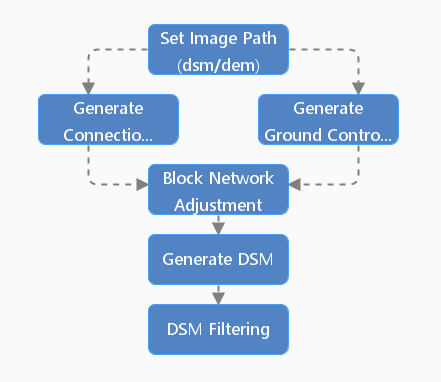 |
| Figure: Single-scene DEM production workflow |