



Feature Description
The error inspector is used to view, locate, and process topology errors after validating the topology, helping users browse, select, fix, and mark exceptions in the check results.
This feature reads the error dataset generated by validate topology, and displays the error type, error object, and related dataset information in the error list. Users can interactively locate error objects between the map and the error list, or select single or multiple error records to perform corresponding processing operations through the context menu.
Application Scenarios
- DLG produce data: After operators complete edge matching of polygon features, they check and batch process surface gaps to ensure the continuity of the result data.
- Watershed area data aggregation: Quality inspectors perform validate topology on merged watershed area data from multiple partitions, and centrally locate and process edge gaps.
- Pre-delivery review: Data managers view the results of topological errors, filter error records that need to be processed or marked as exceptions, and form traceable quality inspection results.
Functional Condition Description
- The error inspector needs to be used after validate topology generates the error dataset. It can be opened automatically after validate topology finishes, or manually add a topology-error dataset.
- The error list supports multi-selection of error records from different datasets or under different topology rules. After multi-selection, the context menu only displays the processing methods common to all selected error records.
Version Information
Starting from SuperMap iDesktopX 2026, it supports multi-selecting topology errors in the error inspector and performing batch processing.
Feature Entry
- In the Validate Topology dialog, check When finished, open the error checker.
- Data tab > Topology group > Error Inspector button.
Operation Instructions
Topology Error Details
- Open the error inspector.
- In the Error Dataset dropdown, select the error dataset to view. You can also click the drop-down button on the right to select Add Topology-error Dataset to add other topology error datasets.
- In the Show dropdown menu, select the topology error type to view. The error inspector refreshes the error list based on the filter criteria and displays the current error count.
- Check or uncheck Display Exception to control whether topology errors marked as exceptions are shown in the error list.
- Click the Topologically Select button to select a topology error dataset on the map and view the corresponding error records.
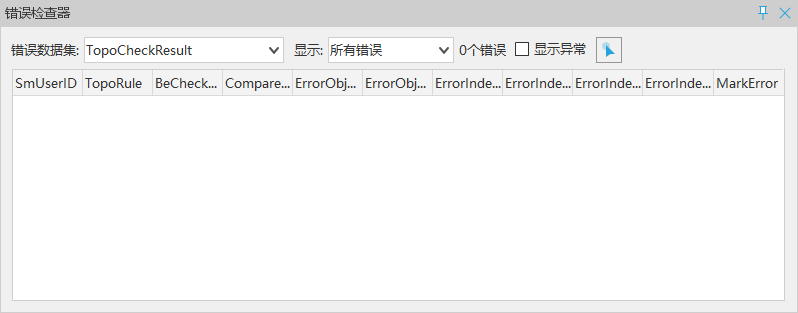
Process Topology Errors
- Select a topology error object on the map, or select an error record in the error list.
- Right-click to open the context menu, and select a processing method according to the error type.
- Zoom to: Zoom the map view to the extent of the current error object.
- Pan to: Pan the map view to the location of the current error object.
- Select Elements: Select the related features involved in this topology error.
- Create Features: Create features based on the error object, commonly used for processing surface gap errors.
- Clip, Ungroup, Split: Repair related features according to topology rules.
- Mark: Mark the error record as an exception or unmark it.
- After successful processing, re-execute validate topology or refresh the error results to confirm whether the errors have been fixed.
Batch Process Topology Errors
- Hold Ctrl or Shift in the error list to select multiple error records.
- Right-click to open the context menu. The system displays common processing methods based on the dataset type and topology rules of the selected error records.
- Select an available batch processing method and execute it. For example, for the no gaps in region error, you can select Create Features to batch create features to fill gaps.
- If the processing method in the context menu is grayed out, it indicates that the currently selected error records do not support this batch operation. You can reduce the selection range, or process by error type separately.
The support of interactive topology processing for datasets and topology rules is shown in the following table:
| Dataset | Dataset Type | Topology Rules | Supported Processing Methods | Batch Support |
|---|---|---|---|---|
| Single Dataset | Region | no overlap in region | Create Features | Batch Supported |
| no overlap in region | Erase | Not Supported | ||
| no overlap in region | Clip | Batch Supported | ||
| no gaps in region | Create Features | Batch Supported | ||
| no complex object | Ungroup | Batch Supported | ||
| Line | no complex object | Ungroup | Batch Supported | |
| no intersect in line | Split | Batch Supported | ||
| no overlap in line | Erase | Not Supported | ||
| Point | no identical points | Erase | Not Supported | |
| Multiple Datasets | Region and Region | region inside not overlap region | Clip | Batch Supported |
| region inside not overlap region | Erase | Not Supported | ||
| Line and Line | line not overlap line | Erase | Not Supported | |
| line not intersect with line | Split | Batch Supported |
Notes
 Notes:
- Processing operations such as Create Features, Clip, Ungroup, and Split will modify related data. Before execution, ensure that the data has been backed up, or that the editing results in the current workspace can be saved.
- When batch processing error records from different datasets or different rules, the system only executes common and available processing methods. After execution, please check whether the processing results meet business requirements.
Related Topics
- Topology Overview
- Topology Preprocessing
- Validate Topology
- Topology Diagram
- Perform a Topology Check Scenario