



Function Description
Using the Explode function, you can decompose selected single or multiple line objects into straight-line objects of the minimum unit.
A straight-line object of the minimum unit indicates that the object has only two nodes (i.e., two endpoints) and is a simple object.
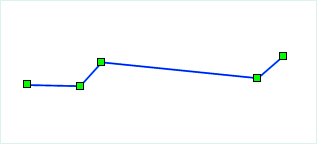
As shown in the figure below, the object to be exploded has 5 nodes (Figure 1); after exploding, the object is decomposed into 4 objects, and each segment contains only 2 nodes. Figure 2 shows the result of applying single-value thematic maps to the exploded multiple objects based on SMID.
 |
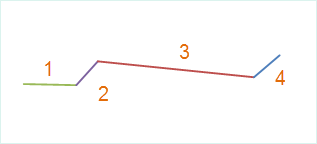 |
| Figure 1: Object before exploding | Figure 2: Objects after exploding |
- The Explode function is applicable to 2D line layers and CAD layers. This function is available when the layer is editable and line objects are selected.
- Complex objects are also suitable for the explode operation. After exploding, the complex object will be decomposed, and each sub-object will be further decomposed into straight-line objects of the minimum unit.
Function Entry
- Edit Data tab -> Object Editing group -> Type Conversion -> Explode
Instructions
- In the editable state of the layer, select one or more line objects to explode.
- In the Edit Data tab, from the Type Conversion dropdown menu, click the Explode button to perform the explode operation.
- After the explode operation is completed, the output window will prompt how many objects have been generated. For example: Line object [smID]=221 was exploded and generated 4 objects in total!
 Notes:
For objects with many nodes such as arcs and circles, after exploding, the newly generated objects may be too small to be displayed at small scales. The application filters and displays small objects; line objects with a length less than 0.4mm will not be displayed. For more information about the minimum object size, please refer to the Object Size Filter Display section in Map Display Optimization.