



Merge
Feature Description
In practical applications, we may need to merge objects. For example, when you want to merge the three provinces of Heilongjiang, Jilin, and Liaoning into the Northeast region on a national administrative map, you can select the three polygon objects of these provinces and use the Merge operation to combine them into the Northeast region. The Merge operation supports polygon or line objects.
During the merge operation, various special situations may occur. These situations are explained below.
- Current Layer Is a Polygon Layer
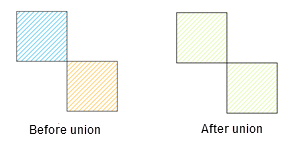
- If the polygons participating in the object operation intersect at points, these polygon objects will be merged into a complex polygon object (as shown in the figure below, generating a complex polygon object with two child objects).
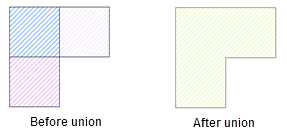
- If the polygons participating in the object operation intersect along lines, the adjacent edges between these polygon objects will disappear, and they will be merged into a simple polygon object.
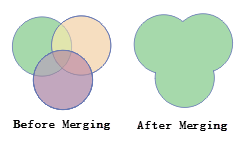
- If the polygons participating in the object operation intersect on areas, they will be merged into a simple polygon object.
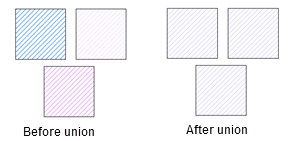
- If the polygons participating in the object operation do not intersect and are not adjacent to each other, a complex polygon object will be generated after merging (as shown in the figure below, generating a complex polygon object with three child objects).
- If the polygons participating in the object operation intersect at points, these polygon objects will be merged into a complex polygon object (as shown in the figure below, generating a complex polygon object with two child objects).
- Current Layer Is a Composite Layer
- In a CAD layer, after line objects, curve objects, elliptic arcs, and arcs participate in the operation, the type of the new object generated is a line object; after polygon objects, rectangles, circle objects, and oblique ellipses participate in the operation, the type of the new object generated is a polygon object.
- Cross-Layer Merge
- When merging across layers, the selected objects from other layers will be merged with the objects in the current editable layer. After the operation, only the objects in the current editable layer are changed; objects in other layers remain unchanged. When multi-layer editing is enabled, you can choose which object to retain in the Merge window. It supports setting whether to delete the unselected objects from the editable layer.
Function Entry
- Edit Data tab -> Object Editing group -> General editing -> Group and Ungroup -> Merge
- In the map -> context menu -> Merge button.
Operation Steps
- In the editable state of the layer, select two or more objects.
- In the Edit Data tab, under the General editing drop-down menu, click the Merge button in the Group and Ungroup group to pop up the Merge dialog box. Then set the following parameters in the dialog box:
- Edit Layer: Displays the layer to be edited. It cannot be manually modified and is determined by the selected save geometry.
- Save Geometry: Select the object to retain from the dropdown list in the Save Geometry input box. The selected objects will be highlighted in the map.
- Save the properties of an object: Displays the attributes of the object selected in Save Geometry, which will also be the attributes of the merged object. Field values can be manually modified.
- Delete Source Object: Only available when merging objects across layers. It is used to set whether to delete objects from non-current editable layers when merging across layers. By default, it is unchecked. If checked, objects from non-current editable layers will be automatically deleted after merging; if unchecked, objects from non-current editable layers are retained.
- After setting the above parameters, click the OK button to complete the object merge.
Related Topics