



SuperMap iDesktopX adopts a Ribbon interface design. This design is work-oriented and can present related functions on the interface based on your operations, making it easy to quickly locate and launch functions, thereby improving operational convenience.
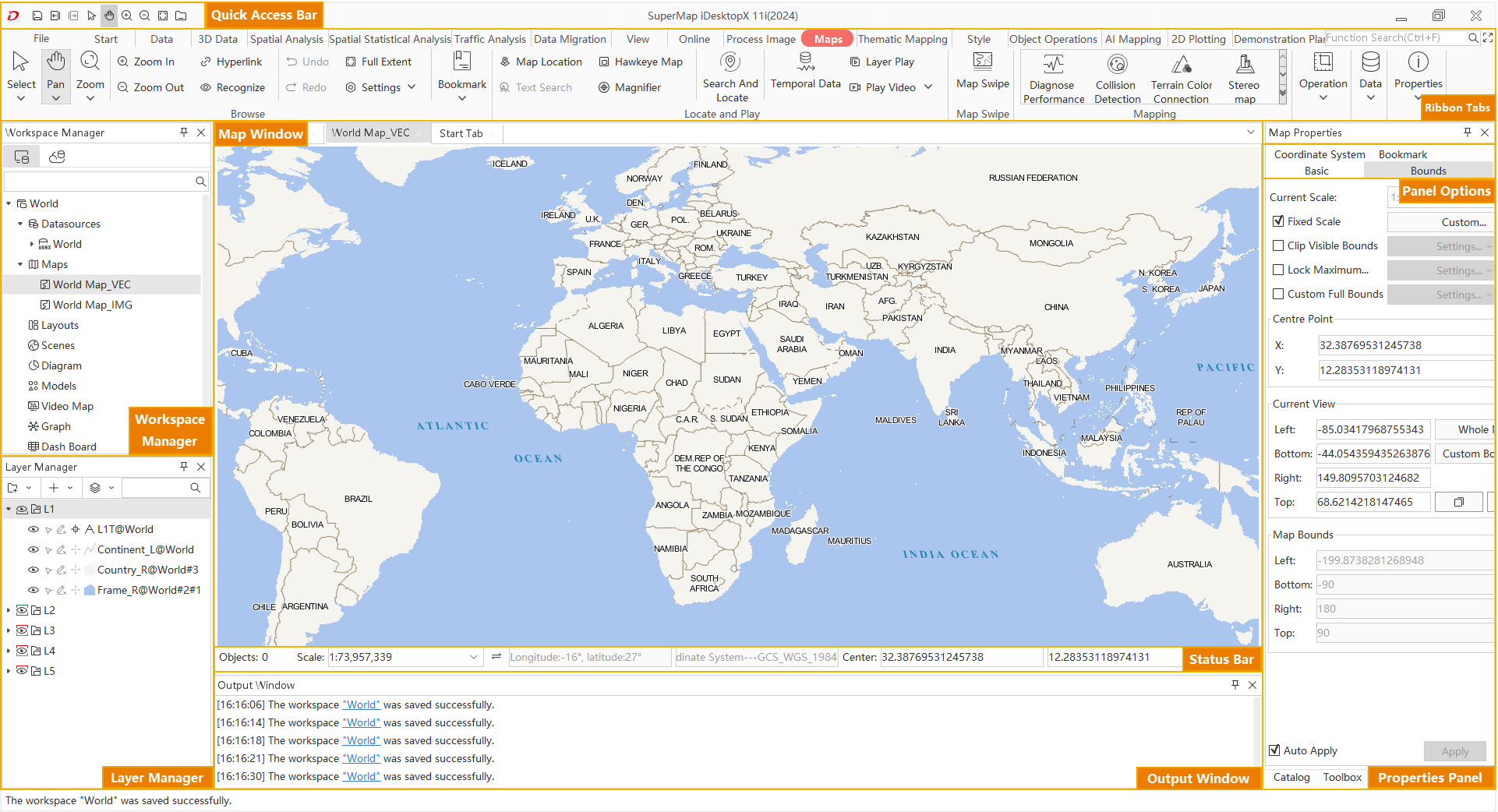
Quick Access Toolbar
The Quick Access Toolbar provides tools for saving the current workspace, switching between front and back views, selecting, roaming, zooming in/out, full view, and quickly opening the program's folder. It improves the efficiency of managing workspaces and maps.
Ribbon Function Area
Unlike traditional GIS software interfaces, in the Ribbon interface, functions are categorized using "tabs" and "function groups". Each tab closely aligns with actual workflow and automatically presents related functions based on your operations. "Function groups" further refine functions within a tab, grouping similar functions together to enhance the efficiency of function discovery and operation.
Contextual Tabs
Contextual tabs are bound to a specific object; they appear on the Ribbon only when that object is activated in the application. For example, when a map is activated, tabs associated with the map, such as "Map", "Theme", "Styles", "Edit Data", appear on the Ribbon. When a scene is activated, tabs associated with the scene, such as "Scene", "Styles", "Flight Management", "Objects", "3D Geodesign", "3D Analysis", appear on the Ribbon. This design temporarily hides unneeded functions, making them appear only when needed, enabling faster and smarter work while keeping the interface clean and straightforward.
Ribbon Controls
The various controls on the Ribbon are Ribbon controls, including drop-down button controls, button controls, text box controls, label controls, combo box controls, ButtonGallery controls, composite box controls, color button controls, and numeric display box controls. Only Ribbon controls can be placed on the Ribbon function area, and Ribbon controls can only be placed on the function area.
Child Windows
The main interface of the SuperMap iDesktopX program is the main window, in which map, scene, layout, and tabular are called child windows of the application. These windows support dragging to float as pop-up windows or free layout.
Workspace Manager
The Workspace Manager is a visual tool for managing workspaces. It uses a tree structure management hierarchy to manage data, including nodes such as datasources, maps, layouts, scenes, and resources. Clicking on these nodes expands or collapses their contents, and it provides rich context menu functionality.
Layer Manager
The Layer Manager is used to manage all layers in the current map or scene. Through the Layer Manager, you can easily control the visibility, editability, and selectability of each layer, and perform related settings such as layer styles and snapping settings.
Status Bars
The status bar is located below the map and displays information such as the scale, coordinate system, and center coordinates of the current map. It helps you quickly understand map-related information.
Output Window
The Output Window is used to display program running information and operation result information.
Panel
Windows docked on the right side of the interface are called panels, such as the toolbox panel, properties panel, and Catalog Manager panel. Panels can be dragged to float as pop-up windows or freely laid out in appropriate positions. They can be docked or hidden on the right side of the interface via the hide/dock button in the upper-right corner. Sub-panels within a panel are referred to as options in this manual, such as basic options and range options.
Window Splitting
When using SuperMap iDesktopX, you can drag the program window to the top of the screen to automatically enter full screen, or drag it to the left or right edge of the screen to automatically display in half screen, facilitating efficient operation and layout in multi-screen environments.