



The storage structure of Chart Data is closely related to the IHO international Electronic Chart standard, and plays an important role in the conversion, display and release of charts.
S-57Data Save
Characteristic Object and Space Object
In the S-57 standard, all objects that describe real-world entities are divided into two categories: feature objects and spatial objects. Feature objects describe entities that have no location or Geometric properties. The spatial object involves the spatial position and shape of the entity, and is mainly used to describe the spatial position characteristics of the entity.
A feature object typically does not contain location data, but it determines its location by establishing a relationship with one or more spatial objects. The spatial object must then be associated with a feature object. This relationship helps to construct a spatial representation of the objects in the chart. As shown in the following figure:
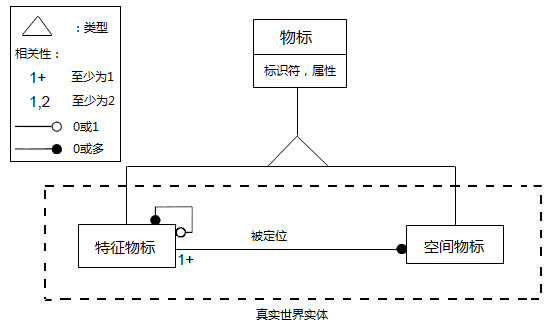 |
| Figure: Relationship between characteristic object and spatial object |
Chart Topology
Chart Data Model: The SuperMap Chart Data model is built according to the S-57 standard. Entities in the real world are defined as a combination of feature objects and spatial objects. Spatial objects are expressed by points, lines and surfaces. Each object contains not only Attributes, but also geometric shapes and spatial positions.
Space description of S-57: S-57 divides space characteristics into three types: vector, grid and matrix, with emphasis on describing vector-type space objects. The spatial relationship of vector objects can be divided into four topological levels: no topology, chain node, planar graph and complete topology.
Topology: The chart uses a chain-node topology, which includes three types of spatial objects: isolated nodes, connected nodes, and edges, and the Topology is established through the relationships between these objects. The Topology of a chart describes how a feature object determines its own Spatial Info with reference to a spatial object. For example, a point object can reference an isolated node or a connected node, a line object can reference an edge and a sequence of connected nodes, and a face object can reference an edge of a closed loop.
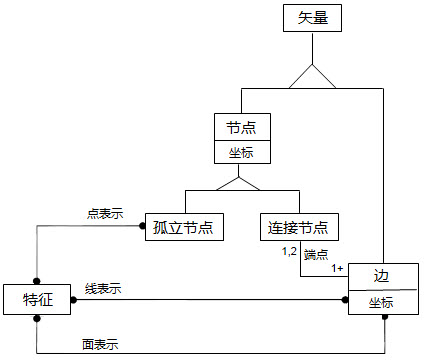 |
| Figure: Chain node model |
Chart Data Storage Structure
The S-57 Electronic Chart uses a Link Node Topology structure and encapsulates data according to the ISO/IEC 8211standard. In order to improve the compatibility with the traditional GIS system, Chart Data adopts a hierarchical storage structure, that is, using Dataset such as point, line and surface to store the characteristic Object Info, and recording the association relationship and reference information between objects through the attribute table.
Because Chart Data contains a wealth of feature object objects, in this structure, a Dataset corresponds to a feature object Object Type, resulting in a chart often contains hundreds or more Datasets, which is not easy to use. Therefore, Chart Dataset Group is used to manage Chart Data.
Chart Data grouping helps manage and organize multiple Datasets, making Chart Data storage and modification more efficient. Multiple Datasets within each Chart Group can work together for data exchange, editing, and publishing. The storage structure is shown in SuperMap as follows:
- Datasource and Chart Group: One or more Chart Groups (Exchange Sets, standard units for data exchange) are stored in one Datasource of SuperMap. It is divided into Editable Chart Group or Non-editable Chart Group. Chart Data editing must be based on a Chart Group.
- Feature Dataset: In a Chart Group, one or more Dataset (Dataset) are stored, also called Feature Dataset. A Dataset corresponds to a File when it is stored.
- Object: Each Dataset stores one or more Object information, and each Object Info corresponds to a Record. Aggregation or Master-Slave can be built between objects.
- Field and sub-field: Each Object Info contains the Field specified in the specification. These fields are also called object attributes. For example, the characteristic object identifier ( FOID, Feature Object Identifier) is the Unique identifier of the object, It is also called the "long name" of the object, the characteristic Record ID (FRID, Feature Record Identifier), and the Object Type. In each field, the corresponding Subfields are stored as required by the specification. For example, FOID needs to contain three subfields: AGEN, FIDN, and FIDS; FRID contains multiple subfields, such as RCID (Record ID), RCNM (Record Name), and so on.
- Object: Each Dataset stores one or more Object information, and each Object Info corresponds to a Record. Aggregation or Master-Slave can be built between objects.
- Feature Dataset: In a Chart Group, one or more Dataset (Dataset) are stored, also called Feature Dataset. A Dataset corresponds to a File when it is stored.
Related topics