URI
<networkDataName_uri>/burst[.<format>]
Supported methods
Parent resource
Introduction
The burst resource represents burst analysis function. By sending a request to burst resource with parameters, you can get critical and normal facility nodes and edges,both upstream and downstream, which are affected by burst point.
Supported Methods:
- GET: Gets the result of burst analysis.
- HEAD: Checks whether the burst resource exists or whether there is a permission to access the resource.
Supported output formats: rjson, json, html, xml.
Resource hierarchy
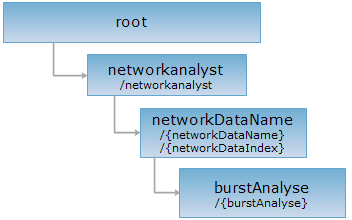
HTTP request methods
Implement the HTTP request on the following URI, where supermapiserver is the server name, with rjson being the output format.
http://supermapiserver:8090/iserver/services/facilityanalyst/rest/networkanalyst/WaterNet@FacilityNet/burst.rjson
GET request
Gets critical facility nodes and edges which affect burst point and normal nodes which are affected by burst point, both upstream and downstream.
Request parameter
Execute a GET request on burst resource. Following arguments need to be included within URI:
| Name | Type | Description |
| sourceNodeIDs | int | [Required] ID array to specify facility nodes. |
| edgeID | int | [Required] The edgeID in traffic network analysis. The request URI shall whether includes edgeID or nodeID, but not both at the same time. |
| nodeID | int | [Required] The nodeID in traffic network analysis. The request URI shall whether includes nodeID or edgeID, but not both at the same time. |
| isUncertainDirectionValid | boolean | Whether edges with uncertain direction is effective. If it is true, the anaysis will keep going down when encounting ucertain direction. Otherwise, it will stop the ansysis in this direction. |
Response structure
Execute the burst function. The returned operation result structure is as follows:
| Field | Type | Description |
| criticalNodes | int | Critical facility nodes which affect burst point, both upstream and downstream. |
| edges | int | Facility edges which affect burst point and which are affected by burst point,both upstream and downstream. |
| normalNodes | int | Normal facility nodes which are affected burst point, both upstream and downstream. |
Response example
Execute burst analysis using WaterNet@FacilityNet dataset by sending a GET request to:
http://supermapiserver:8090/iserver/services/facility/rest/networkanalyst/WaterNet@FacilityNet/burst.rjson?sourceNodeIDs=%5B84,85%5D&edgeID=310&isUncertainDirectionValid=false
The response result returned is as follows:
{
"criticalNodes": [],
"edges": [
207,
208,
209,
213,
223,
224,
225,
234,
280,
295,
299,
310,
336,
337,
344,
347,
352,
354,
358,
360,
365,
375,
382,
387,
408,
409,
410,
412,
416,
417,
419,
420,
422,
452,
457,
459,
465,
470,
487,
488,
489,
492,
493
],
"normalNodes": []
}
HEAD request
Asks for the response identical to the one that would correspond to a GET request, but without the response body. This is useful for retrieving meta-information contained in response headers, without having to transport the entire content. The meta-information includes the media-type, content-encoding, transfer-encoding, content-length, etc.
HEAD request can be used to check whether the burst resource exists, or whether the client has the permission to access it. It can also determine if the burst resource supports an output format <format> if performed on a URI with .<format> included.