URI
<vectorStyles_uri>/{layerName}[.<format>]
Supported methods
Parent resource
Introduction
vectorStyle represents the style information of a layer, which is identified by the layer name in the URI.
Supported Methods:
- GET: Get the style information for the layer.
- PUT: Create or modify the layer style information
- HEAD: Check whether the vectorStyle resource exists. And whether there is privilege to access the resource.
Supported output formats: rjson, json, html, xml.
Resource hierarchy
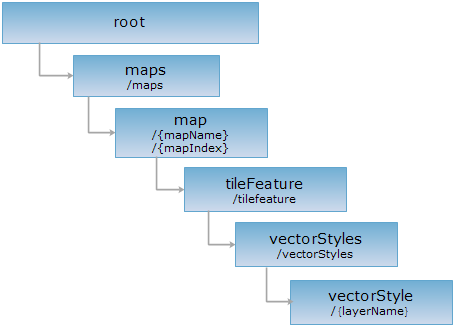
HTTP request methods
Implement the HTTP request on the following URI, where supermapiserver is the server name, with rjson being the output format.
http://supermapiserver:8090/iserver/services/map-China400/rest/maps/China/tileFeature/vectorstyles/China_Nation_txt_1@China.rjson
GET request
Get the style information for the layer.
Request parameter
Request a GET request for a vectorStyle resource to get the style information for the specified layer in the map. You need to include the relevant parameters in the URI. If no parameters are specified, the style information for all the layers in the map is acquired by default. The parameters are:
| Name | Type | Description |
| type | VectorStyleType | The description language type of the layer style. Currently only supports CartoCSS language. |
Response structure
Return the layer style information.
| Field | Type | Description |
| type | VectorStyleType | The description language type of the layer style. |
| style | String | The layer style information. It includes the layer name and its style. |
Response example
To request the style information of the China_Nation_txt_1@China layer in the China map on the vectorStyle resource, it is needed to perform GET request: http://supermapiserver:8090/iserver/services/map-china/rest/maps/China/tileFeature/vectorstyles/Country_R@China?type=cartoCSS
Te returned …… is as follows:
PUT request
It means to create the layer and its style or modify the layer style information. When the vectorStyle resource does not exist, it means to create, otherwise it means to modify.
Note: the PUT request is supported only for map services whose service provider is SVTiles.
Request parameter
When the vectorStyle resource does not exist, for a new URI, such as: http: // supermapiserver: 8090 / iserver / services / map-svtiles-China / rest / maps / China / tileFeature / vectorStyles / china_1 @ China? ReturnPutAction = true, if sending a PUT request on it, you need to enter the style information in the request body when creating the dataset. Examples are as follows:
{
"style": "#China_1@China[zoom<=1.3521308572821239E-8][zoom>=6.760654286410611E-9]{text-placement-type:simple;text-placements:\"E,NE,SE,W,NW,SW\";line-color:rgba(245,243,240,1);line-width:1;line-pattern-file:url(SYMBOLLINE__China_Nation_txt_1@China__64__64__true__605218360.png);polygon-fill:rgba(208,255,240,1);polygon-pattern-file:url(SYMBOLFILL__China_Nation_txt_1@China__64__64__true__605218360.png);point-file:url(SYMBOLMARKER__China_Nation_txt_1@China__64__64__true__605218360.png);polygon-opacity:1;polygon-pattern-opacity:3;}",
"type": "cartoCSS"
}
When modifying the vectorStyle resource, modify the parameter value in the request body.
Response structure
When the modifications are successful, the created or modified style information will be returned. Expressed in rjson format as follows:
{
"style": "#China_1@China[zoom<=1.3521308572821239E-8][zoom>=6.760654286410611E-9]{text-placement-type:simple;text-placements:\"E,NE,SE,W,NW,SW\";line-color:rgba(245,243,240,1);line-width:1;line-pattern-file:url(SYMBOLLINE__China_Nation_txt_1@China__64__64__true__605218360.png);polygon-fill:rgba(208,255,240,1);polygon-pattern-file:url(SYMBOLFILL__China_Nation_txt_1@China__64__64__true__605218360.png);point-file:url(SYMBOLMARKER__China_Nation_txt_1@China__64__64__true__605218360.png);polygon-opacity:1;polygon-pattern-opacity:3;}",
"type": "cartoCSS"
}
HEAD request
Returns the same HTTP response header as the GET request, but does not have the response entity. It can get the metadata information in the response header without transferring the whole response content. Metadata information includes media type, character encoding, compression encoding, entity content length, and so on.
The HEAD request can be used to determine whether the vectorStyle resource exists or whether the client has authority to access the resource. It can quickly determine whether the vectorStyle resource supports the representation in <format> format by performing HEAD request on URI with <format>.