URI
<blankRegions uri>/retilejob[.<format>]
Supported methods
Parent resource
Introduction
The blank region retile job resource. You can get the address of the tile task resource generated from retiling through the GET request.
Supported Methods:
- GET: Gets the address of the tile task resource generated from retiling.
- HEAD: Checks whether the retileJob resource exists or whether it has permission to access the resource.
Supported output formats: rjson, json, html, xml.
Resource hierarchy
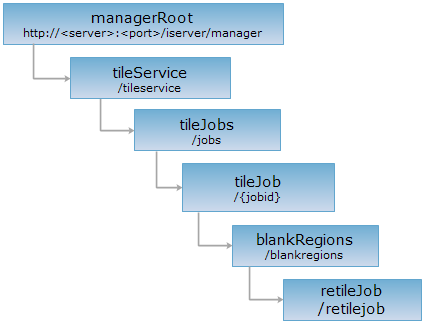
HTTP request methods
Implement the HTTP request on the following URI, where supermapiserver is the server name, with rjson being the output format.
http://supermapiserver:8090/iserver/manager/tileservice/jobs/af971870-6f12-49a7-83dd-4d8798d9d41b/blankregions/retilejob.rjson
GET request
Gets the address of the tile task resource generated from retiling.
Response structure
The returned result for implementing the GET request on the retileJob resource is as follows:
| Field | Type | Description |
| reTileJobUrl | String | The address of the tile task resource generated from retiling. |
Response example
The returned rjson format representation after implementing the GET request on the retileJob resource http://localhost:8090/iserver/manager/tileservice/jobs/af971870-6f12-49a7-83dd-4d8798d9d41b/blankregions/retilejob.rjson is as follows:
http://localhost:8090/iserver/manager/tileservice/jobs/cd517207-d86f-4d9a-b96f-4848efa70aaa
HEAD request
Asks for the response identical to the one that would correspond to a GET request, but without the response body. This is useful for retrieving meta-information written in response headers, without having to transport the entire content. The meta-information includes the media-type, content-encoding, transfer-encoding, content-length, etc.
HEAD request can be used to check if the retileJob resource exists, or if the retileJob resource can be accessed by clients. It can also determine if the retileJob resource supports an output format <format> if performed on a URI with .<format> included.