

URI
<users_uri>/registered[.<format>]
Supported Methods
Parent Resource
Introduction
The registered resource is used to verify whether a specified username has already been registered.
Supported Methods:
- GET: Check whether a username has already been registered in iPortal.
- HEAD: Check whether the registered resource exists, or whether the permission can access the registered resource.
Supported output formats: RJSON, JSON, XML.
Resource hierarchy
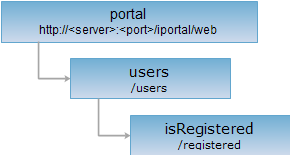
HTTP Request Method
Perform an HTTP request on the following URI. The rjson output format is used as an example, where supermapiportal is the server name.
http://supermapiportal:8190/iportal/web/users/registered.rjson
GET Request
Verify whether a specified username has already been registered in iPortal.
Request Parameters
When sending a request, you need to include the following query parameters in the URI.
| Name | Type | Description |
| username | String | The username to be queried. |
Response Structure
Returns a boolean value. true indicates that the username has already been registered, and false indicates that the username has not been registered.
Response Example
Perform a GET request on the registered resource: http://localhost:8190/iportal/web/users/registered.rjson?username=test to check whether "test" has already been registered as a username in iPortal. The returned rjson representation is as follows:
false
HEAD Request
Returns the same HTTP response headers as a GET request, but without a response entity. You can obtain the metadata information contained in the response message headers without transferring the entire response content. The metadata information includes media type, character encoding, compression encoding, entity content length, etc.
A HEAD request can be used to determine whether the registered resource exists, or whether the client has permission to access the registered resource. By performing a HEAD request on a URI with .<format> appended, you can also quickly determine whether the registered resource supports the <format> representation.
See