



Fillet
Function Description
In the Object Editing group on the Edit Data tab, a function to create a fillet is provided. It extends or trims the nearby endpoints of two line segments and connects them with an arc tangent to both lines to form a rounded corner.
- The Fillet button is only available when two line segments are selected in an editable layer, meaning this function works only on the two selected line segments.
- The objects involved in creating the fillet must be simple line objects, and their extensions must have exactly one intersection. If the two lines are parallel or collinear, the operation will fail.
- After the operation, the source lines may be extended or trimmed, but their attributes will not change.
- Although a fillet operation can be performed on intersecting lines, it has no significant geometric meaning, so this case is not described in detail.
Function Entry
- Edit Data Tab -> Object Editing Group -> Line Editing -> Endpoint Editing -> Fillet
Instructions
- Set the layer of the line segments to be filleted as the current editable layer.
- Select two line segment objects (non-parallel lines) simultaneously in the layer.
- In the Line Editing drop-down menu on the Edit Data tab, click the Fillet button in the Endpoint Editing group. The Fillet Settings dialog box will appear. The default fillet radius is one-fifth of the maximum inscribed circle radius of the two line segments. The unit of the fillet radius is consistent with the unit of the current editable layer.
- Set the arc radius, which is the radius of the arc tangent to both lines. The result of the fillet operation will be determined by the user-set arc radius, which decides the position and size of the fillet. Accordingly, the two line segments will be appropriately extended or trimmed. As the arc radius is modified, the preview will display the result of the fillet operation in real time, making it convenient for the user to adjust.
- Set whether to trim the source object. Check the option to trim the source object after the operation; otherwise, the original object will be retained.
- A preview of the fillet result will be displayed in real time on the map. Click the OK button to execute the fillet creation based on the user's settings. The result is shown in the figure below.
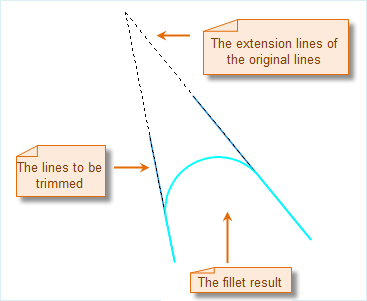
Figure: Fillet Result - Explanation of the operation result: The system calculates an inscribed circle with the input radius between the two selected line segments, and finds the tangent points of each line segment on that circle. If a tangent point lies on the line segment, the segment is cut off at that point; if it lies on the extension line, the endpoint of the segment is extended to the tangent point. Then, the outer arc between the two tangent points on the inscribed circle is taken to generate a new line object. Its attribute record is appended to the end of the attribute table. System fields are assigned by the system; non-system fields are empty. The original line objects retain their original attributes. The diagram below illustrates the operation process and result:
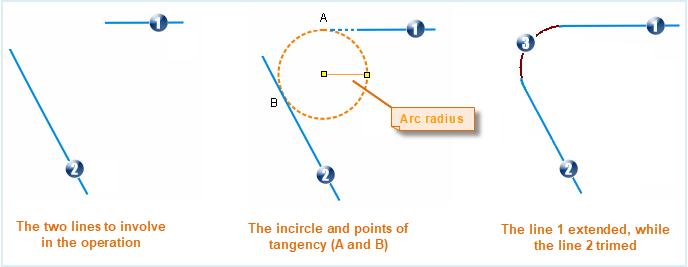
Figure: Operation Process and Result Diagram