



Feature Description
The automatic mapping tool can create a map based on the input datasets and corresponding layer property templates, and save the map to the workspace. Currently, the automatic mapping tool does not support automatic mapping for distributed data.
Automatic mapping can accept multiple datasets as multiple layers in the map. The overlay order of layers in the map is determined by the order of datasets in the layer dataset. The following figure shows the SuperMap iDesktopX parameter panel. The layer dataset in the panel is an ordered list, and the sequence number in the list indicates the order of the corresponding layer in the map. For example, sequence number 1 represents the topmost layer in the map.
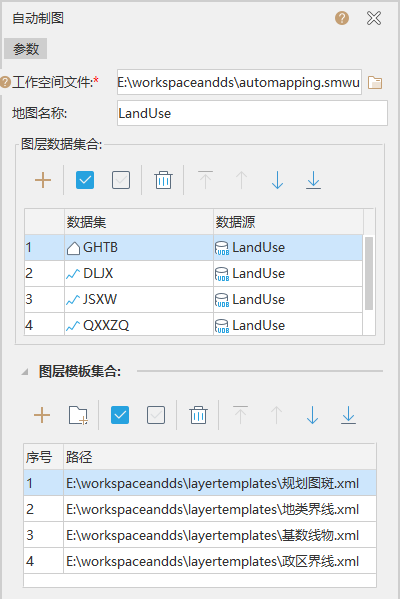
The members in the 'layer template collection' of automatic mapping have a one-to-one correspondence with the members in the layer dataset. That is, the layer template with sequence number 1 will serve as the display style template for the layer data with sequence number 1 in the layer dataset, and so on.
Parameter description
| Parameter Name | Default Value | parameter interpretation | parameter type |
|---|---|---|---|
| workspace file | The full path of the workspace file where the resulting map is saved. Currently, only local file workspace is supported. If the workspace file does not exist, it will be created automatically. | String | |
| map name | The name of the map. If the map name duplicates an existing map in the workspace, ' _ ' + a sequence number will be appended to the map name. | String | |
| map properties | Settings related to map properties, such as anti-aliasing settings, overlap settings, label always top, show full label, map background, map clipping display, map dynamic projection, map fixed scale, etc. Map properties are specified through a map template file. This parameter is the full path of the map template file (.xml), supporting only local file paths. The map template can be created and exported using SuperMap iDesktopX. All contents related to map properties settings in the map template will be applied to the resulting map of automatic mapping. 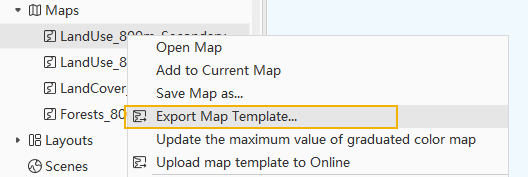 If this parameter is not set, the resulting map will use the default map properties settings. The layer style and property settings of the resulting map will not use the contents from the map template but will use the configuration of the 'layer template collection' parameter. |
String | |
| layer dataset | A collection of datasets for mapping. One dataset corresponds to one layer in the map. The order of layers in the map is consistent with the order of datasets in the collection. The first dataset in the collection is the topmost layer. | Dataset | |
| layer template collection | Use layer property templates to configure the display style for the data in the layer dataset. Both this collection and the layer dataset are ordered collections. The items in the two collections have a one-to-one correspondence. Each item in this collection is the full path of a layer property template file, supporting only local paths. The layer property template is an XML file that can be created and exported using SuperMap iDesktopX. As shown in the figure below, for a normal layer or image layer, select the layer and export it as a layer property template. 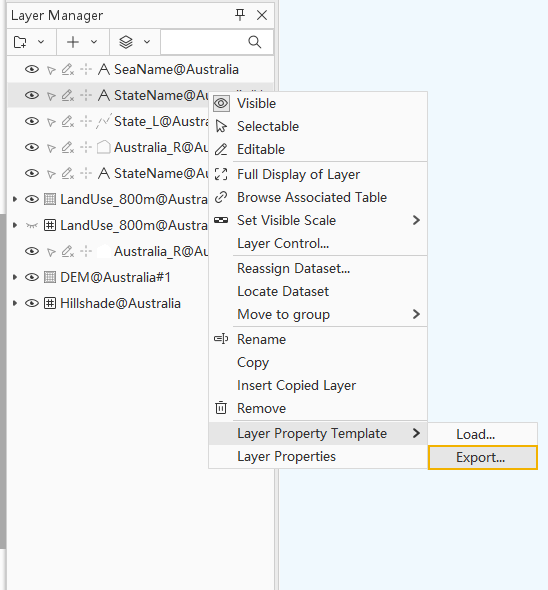 For thematic layers, select the thematic layer and export it as a layer property template, not as a thematic map template. For mosaic dataset layers, as shown in the figure below, select the mosaic dataset image layer and export it as a layer property template. If this parameter is not set, the default layer style and property settings will be used. 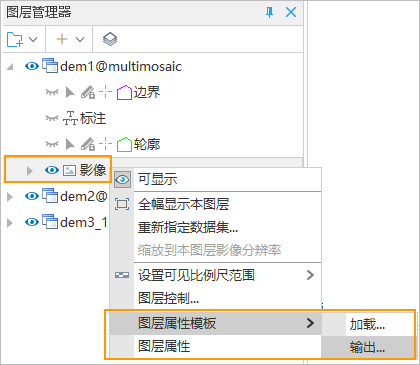 |
String |
Output Result
The output result of the automatic mapping tool has two parts:
Map name: the name of the resulting map.
Workspace: the full path of the workspace file where the resulting map is saved.