



Instructions for use
Five Crucial Steps are shared by Chart Data Production Containing Data Preprocessing, Chart Group Creation, Chart Data Processing, Chart Data Check and Chart Data, as shown in the following figure. These steps correspond to different chart production tools, which are used to produce and share Chart Data conforming to S-57 standard.
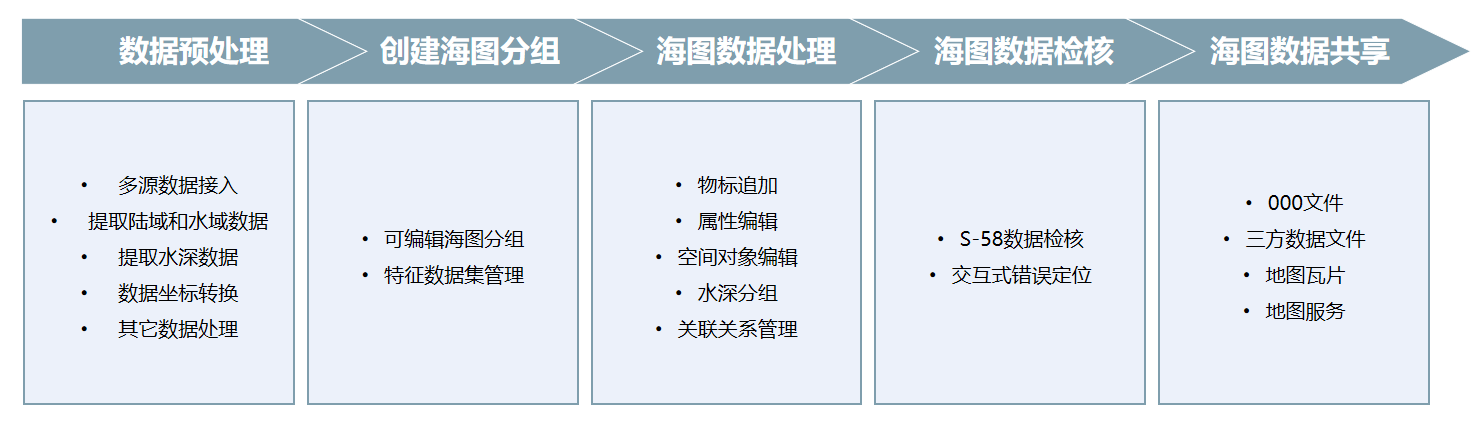 |
| Figure: Key Chart Data Production and Release Processes |
SuperMap supports two Chart Data production modes: one is to produce a new Chart Data, and the other is to modify and update the existing Chart Data. Whether the data is re-produced or the Existing data is modified, the operation shall be performed based on the editable chart Dataset Group. To generate a new Chart Data, create a new Chart Dataset Group in Datasource to edit the Chart Data; To modify the existing Chart Data, after importing 000 file, convert the Dataset Group to the editable type Dataset Group to edit and modify the existing Chart Data.
When the chart Dataset Group is editable, you can edit Chart Data, such as adding feature object, editing Object Properties, editing water depth point, and creating feature object association. After the editing is completed, the Topology of the chain node of the chart needs to be reconstructed, and then the Check Data is carried out, and the checked errors are corrected until the check is correct.
After the Check Data is correct, the chart Dataset Group needs to be converted to read-only type, and then the chart Data Export function can be used to export the chart Data to 000 file. If necessary, third-party software can be used to check the 000 file and release Chart Data after checking.
Editing Chart Data in strict accordance with the above process can effectively ensure the correctness of Chart Data and effective data exchange and transmission. Check Data is like a security inspector of data quality. If the Chart Data containing errors is released without passing the security check, it may bring hidden dangers to navigation safety.